
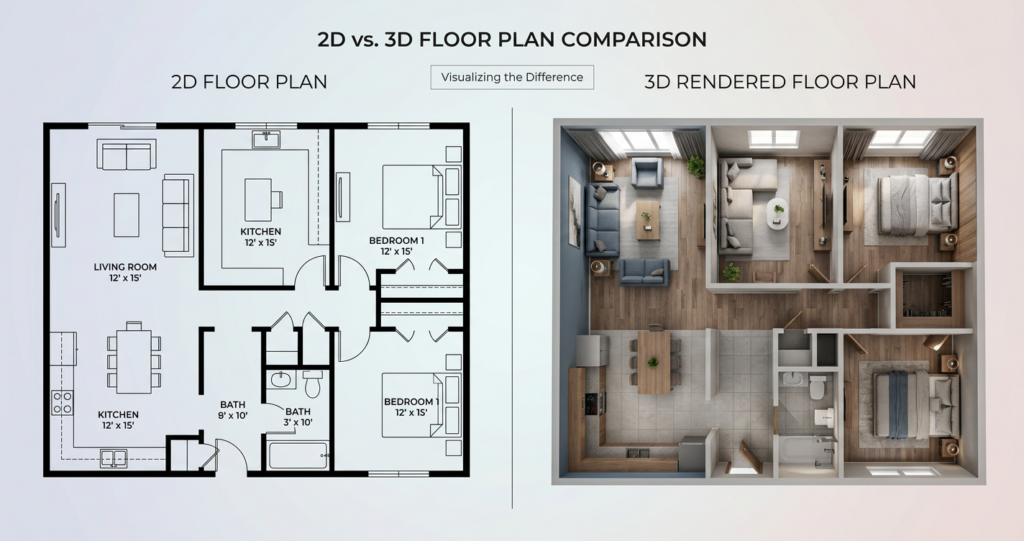
Why Buyers Trust 3D Rendered Plans More Than 2D Floor Plans
In the high-stakes world of real estate, the first point of contact between a buyer and their future home often happens on a screen. For decades, the standard tool for this interaction was the 2D floor plan—a flat, technical drawing filled with symbols and measurements. However, a significant shift has occurred. Modern buyers are increasingly leaning toward, and more importantly, trusting 3D rendered plans over traditional blueprints.
But why does a three-dimensional representation carry so much more weight? The answer lies at the intersection of cognitive psychology, emotional resonance, and technological transparency.
1. Reducing the “Cognitive Load” of Visualization
The struggle with 2D floor plans versus the ease of 3D versions is primarily rooted in cognitive psychology and how our brains process spatial information. While professionals are trained to “read” technical symbols, the average person must perform significant mental work to interpret a 2D drawing.
1. The High “Cognitive Load” of 2D
Understanding a 2D floor plan is a complex mental task known as dimensionality crossing.
- Mental Translation: When looking at a 2D plan, your brain must translate flat lines, abstract symbols, and text into a 3D reality.
- Missing Data: 2D plans lack depth, height, and texture. To understand the space, you have to mentally “extrude” walls and imagine the volume of the rooms, which creates a high cognitive load.
- Decision Fatigue: When cognitive load is high, decision-making slows down. This is why clients often hesitate or say they “can\’t quite picture it” when presented with only blueprints.
2. Why 3D is Naturally “Intuitive”
The human brain is biologically wired for 3D processing because we navigate the physical world in three dimensions.
- Instant Recognition: Research suggests the brain processes images up to 60,000 times faster than text or abstract line drawings. A 3D plan allows a viewer to “get it” in milliseconds.
- Spatial Logic: 3D plans provide immediate context for scale and volume. For example, in 3D, a buyer can see exactly how a King-size bed fits in a room, whereas in 2D, it is just a square with dimensions that require mental calculation.
3. The “Livability” Factor
Beyond just “understanding” where walls are, 3D plans allow for an emotional connection that 2D cannot provide.
- Visual Soul: While 2D is the “technical skeleton,” 3D is the “visual soul” of a project. It includes light, shadow, and textures (like hardwood vs. tile) that help a buyer imagine living in the space.
- Flow and Circulation: 3D models make “circulation flow”—the way people move between rooms—much clearer. It turns a technical diagram into a destination rather than just a map.
Comparison Summary
| Feature [2, 3, 4, 5, 7, 8] | 2D Floor Plan | 3D Floor Plan |
| Perspective | Flat, top-down | Realistic, isometric |
| Brain Processing | Abstract/Symbolic (High effort) | Lifelike/Spatial (Natural) |
| Primary Use | Permits & Construction | Marketing & Sales |
| Spatial Detail | Measurements only | Height, volume, & scale |
- 2. Building an Emotional Connection
3D floor plans build an emotional connection by transforming a technical blueprint into a livable narrative. While 2D plans focus on “what” the space is (measurements and walls), 3D plans focus on “how” the space feels, allowing buyers to move from logical analysis to emotional aspiration. [1, 2, 3, 4, 5]
1. Visualization of a Future Lifestyle
3D renders act as a “visual soul” for a property. By including photorealistic furniture, decor, and textures, they help buyers stop looking at a construction project and start looking at a home.
- Narrative Details: Small touches like a fuming coffee cup on a counter or a book on a bedside table trigger “micro-stories” that help buyers imagine their daily routines.
- Scene-Setting: Instead of an empty rectangle, a buyer sees a sun-drenched reading nook or a warm kitchen at sunrise, evoking immediate feelings of comfort and belonging.
2. Reducing Anxiety through Spatial Clarity
One of the biggest emotional barriers to a sale is the fear of the unknown.
- Truthful Views: For unbuilt properties, 3D plans eliminate the “imagination gap.” When a buyer can see exactly how high the ceilings are or how natural light enters a room, their anxiety is replaced by confidence.
- Flow and Circulation: 3D models allow buyers to virtually “walk” through the space. Understanding how rooms connect—such as the distance from the kitchen to the dining area—creates a sense of ease and logical flow that makes the property feel “right”.
3. Personal Ownership and Interaction
Modern 3D tools allow buyers to participate in the design, which builds a psychological sense of pre-ownership.
- Customization: When a buyer can toggle between different flooring materials or wall colours in a 3D plan, they stop being a passive viewer and become a co-creator.
- Furniture Planning: Being able to virtually place their own bed or sofa in the space helps them “mentally move in” before they\’ve even signed a contract.
4. Direct Visual Engagement
The human brain processes visual information significantly faster than technical text or symbols.
- The “Wow” Factor: High-quality 3D renders capture attention and generate excitement much more effectively than “dull” 2D blueprints.
- Memorable Impressions: Interactive 3D tours create a more durable mental image of a property compared to static photos, which often blur together after viewing multiple listings.
3. Radical Transparency and Reduced Risk
Trust is the most valuable currency in real estate. 3D renders build this trust by eliminating “unknowns.”
- Showcasing the Unbuilt: For pre-construction or off-plan properties, 3D renderingis often the only way for a buyer to see what they are actually purchasing. It provides a “truthful view” of the property in all its glory, even if it only exists on paper today.
- Avoiding “Buyer’s Remorse”: One of the biggest fears for a buyer is that the finished home won\’t match their expectations. 3D plans significantly reduce this risk by providing accurate representations of scale, lighting, and finishes. When a buyer understands exactly what they are getting, there are fewer “nasty surprises” during the final walkthrough.
4. Interactive Experiences and Customization
Modern technology has evolved static images into immersive experiences that further cement buyer trust.
- Virtual Walkthroughs: Tools like 360-degree virtual tours allow buyers to explore a property at their own pace, moving from room to room as if they were physically present. This level of interactivity is particularly crucial for remote buyers or those looking at luxury properties.
- Real-Time Personalization: Some 3D tools allow buyers to experiment with different finishes—switching wall colours, flooring materials, or kitchen layouts with a few clicks. This “hands-on” approach not only increases engagement but also gives the buyer a sense of ownership and control over the project before it\’s even finished.
5. Signalling Professionalism and Quality
In a crowded market, the quality of a property\’s presentation often reflects the quality of the developer or agent behind it.
- The “Wow” Factor: High-quality, photorealistic renders are eye-catching and memorable. They signal that a developer is quality-conscious, innovative, and buyer-centric.
- Efficiency in Communication: 3D renders simplify the feedback loop. If a buyer is unsure about a design element, it can be adjusted digitally in real-time, preventing expensive change orders during the actual construction phase.
Conclusion: The Future is Rendered
While 2D floor plans remain essential for the “permit and build” phase due to their mathematical precision, they often fall short during the “pitch and sell” phase. For today\’s buyers—particularly Millennials and Gen Z who expect high-definition, interactive content—3D rendering is no longer a luxury; it is a necessity for establishing trust.
By bridging the gap between technical vision and human experience, 3D rendered plans allow buyers to move from a state of confusion to a state of absolute confidence. In an industry where “seeing is believing,” 3D rendering ensures that buyers don\’t just see a house—they see their future home.
Transitioning from 2D to 3D plans is one of the most effective ways to build immediate buyer confidence. While 2D plans provide technical accuracy, 3D renderings offer a realistic and emotional experience that makes a property feel like a home.
10 FAQs
1. What is the main difference between a 2D and 3D floor plan?
A 2D plan is a flat, top-down technical drawing showing walls and measurements with simple lines. A 3D plan adds depth, furniture, textures, and lighting, allowing you to see the space from a realistic, angled perspective.
2. Why do buyers find 3D plans easier to understand?
Most people aren\’t trained to read architectural blueprints. 3D renderings reduce “cognitive load” by showing how rooms actually look and connect, removing the guesswork required to interpret symbols.
3. Can a 3D floor plan show furniture at a true scale?
Yes. 3D plans allow you to see exactly how a king-size bed or a large dining table fits within a room. This helps buyers confirm that their existing furniture will fit before they commit to a purchase.
4. How does 3D rendering help with emotional connection?
Unlike flat diagrams, 3D renders incorporate sensory details like sunlight streaming through windows and realistic flooring textures. This helps buyers imagine their lifestyle in the space, which is a major driver in home buying.
5. Are 3D floor plans more accurate than 2D plans?
Both are accurate if based on the same data, but they serve different purposes. 2D plans are better for technical construction measurements, while 3D plans provide better “spatial accuracy” for understanding volume and flow.
6. Do 3D floor plans help sell properties faster?
Research indicates that listings with 3D floor plans can sell up to 30% faster. They generate more qualified leads because buyers feel more confident about the property before visiting in person.
7. Can I see lighting and materials in a 3D plan?
Yes. 3D rendering allows you to visualize specific finishes—like white oak flooring vs. grey tile—and how natural light interacts with those materials throughout the day.
8. Are 2D floor plans still necessary if I have a 3D render?
Absolutely. 2D plans remain the “technical skeleton” required for building permits, contractor instructions, and precise structural details. Most experts recommend using both side-by-side.
9. How do 3D plans reduce “buyer\’s remorse”?
By providing a clear visual before construction or purchase, 3D plans prevent “nasty surprises” during the final walkthrough. Buyers know exactly what they are getting, which significantly lowers the risk of post-purchase regret.
10. Can 3D plans help with remote or international buyers?
Yes. Interactive 3D walkthroughs allow out-of-town buyers to explore a property as if they were physically there, making them much more likely to make an offer without a physical visit.