

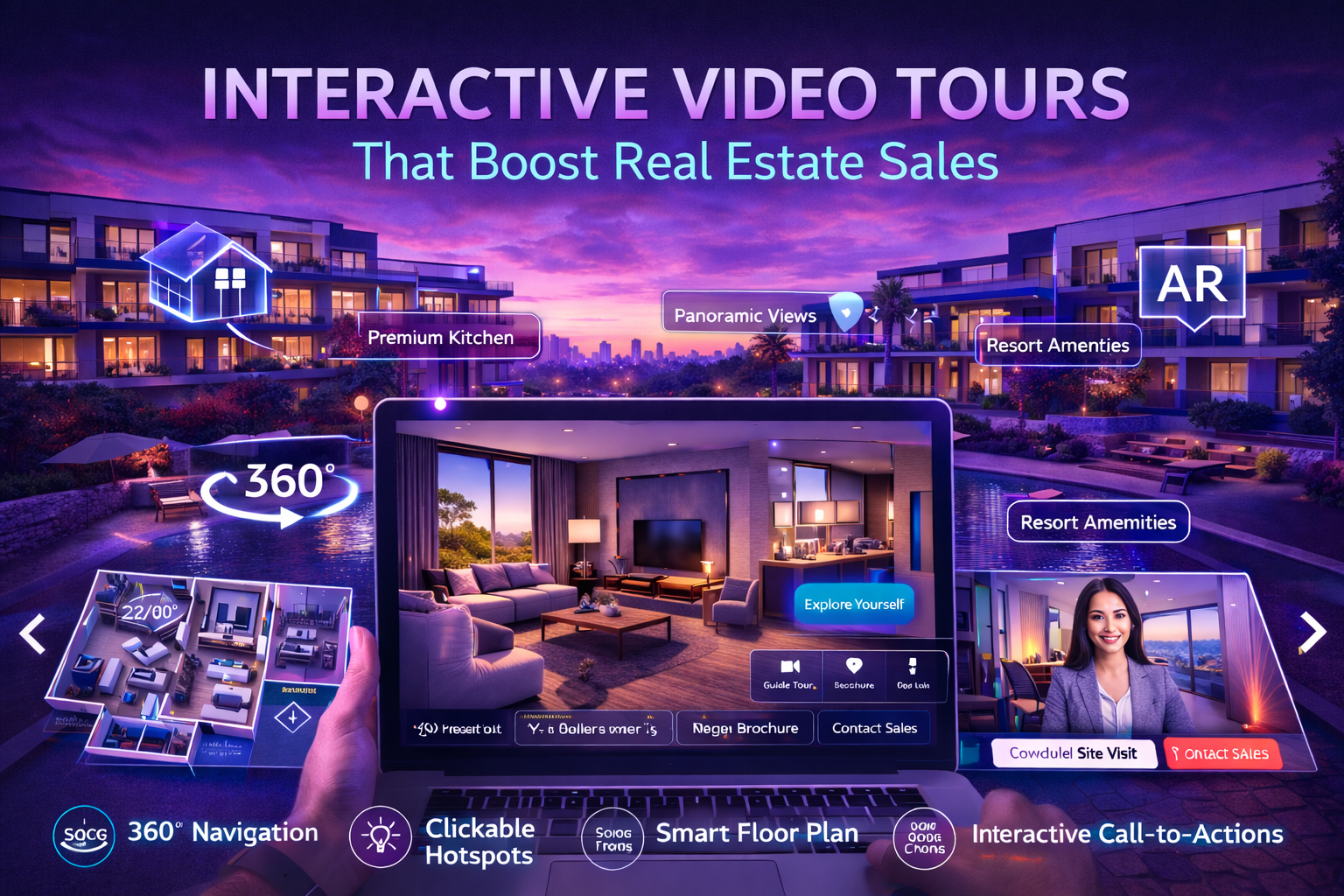
In 2026, the real estate market is no longer defined by physical footfall but by digital engagement. With the rise of the “digital-first” homebuyer, traditional static photos and even standard videos are being outpaced by a more powerful tool: Interactive Video Tours.
Unlike a passive video that a viewer simply watches, an interactive tour allows the user to control the narrative—choosing which room to enter, zooming in on premium finishes, and accessing real-time data. Here are five ways these tours are revolutionizing sales for modern real estate projects.
1. Drastically Reducing the Sales Cycle
Time is the greatest friction in real estate. Traditionally, a buyer might take weeks to coordinate a physical site visit. Interactive tours eliminate this wait time entirely.
- Instant Gratification: Buyers can explore a property the moment they discover the listing.
- Qualified Lead Filtering: By the time a prospect requests an in-person visit, they have already “vetted” the layout and design. This means your sales team spends time only with high-intent buyers, leading to closing rates that are up to 30% faster than traditional methods.
2. Creating an Unbreakable Emotional Connection
Buying a home is an emotional journey. Static images often fail to capture the “vibe” of a space.
- The Power of Agency: When a user clicks to open a balcony door or “walks” from the master suite to the kitchen, they begin to build a mental map of their life in that space.
- Psychology of Ownership: This interactivity triggers a “sense of ownership.” In 2026, data shows that listings with interactive content see 87% more views because they offer a memorable, sensory-rich experience that static ads simply cannot replicate.
3. Global Reach: Selling to the World from Your Office
For projects in high-growth hubs, your best buyer might not be local. They could be an NRI (Non-Resident Indian) in London or an investor in Dubai.
- Eliminating Geography: An interactive tour acts as a 24/7 open house accessible from any continent.
- Trust Through Transparency: Unlike edited photos that might hide flaws, a 360-degree interactive tour provides total transparency. This level of honesty is critical for out-of-station investors who need to feel 100% confident before transferring a booking amount.
4. Interactive “Data Hotspots” for Informed Decisions
One of the most powerful features of 2026 interactive tours is the inclusion of Hotspots. These are clickable icons placed within the tour that provide instant information.
- Feature Highlights: A buyer can click on a kitchen countertop to see a popup about the “Imported Italian Marble” used, or click a window to see a drone-captured view of the actual skyline.
- Contextual Selling: You can embed floor plans, amenity brochures, or even a “Book Now” button directly inside the tour. This keeps the buyer within your sales ecosystem without them having to navigate away to find answers.
5. Higher ROI on Marketing Spend
Marketing budgets are often stretched thin across hoardings, print ads, and social media. Interactive tours offer a unique “multiplying” effect on your ROI.
- Versatility of Assets: A single interactive tour can be broken down into short-form reels for Instagram, high-res snippets for WhatsApp, and a hero feature for your website.
- SEO & Engagement: Google’s 2026 algorithms prioritize “time-on-page.” Because users spend significantly more time interacting with a tour than looking at a photo, your project’s website ranking naturally climbs, driving more organic (free) traffic to your sales funnel.
Comparison: Static vs. Interactive Marketing (2026 Data)
| Feature | Static Photos/Video | Interactive Video Tours |
| Average Engagement Time | 45 Seconds | 5–8 Minutes |
| Inquiry-to-Sales Ratio | 1:15 | 1:6 |
| Impact on Closing Speed | Standard | 20–30% Faster |
| Buyer Trust Level | Moderate | High (Transparent) |
Final Thoughts
In an era where attention is the new currency, Interactive Video Tours are the ultimate tool to capture and hold it. They bridge the gap between imagination and reality, allowing your project to stand out in a crowded marketplace. By providing a transparent, immersive, and convenient experience, you aren’t just showing a property—you are inviting a buyer home.
FAQs
1. What exactly makes a video tour “interactive” compared to a standard walkthrough?
A standard walkthrough is a passive experience where the viewer simply watches a pre-recorded path. In contrast, an interactive video tour gives the user total control. In 2026, this means users can click on “hotspots” to move between rooms, rotate their view 360 degrees, and interact with the environment. For example, a user can click on a kitchen cabinet to see its internal storage or tap a window to view the actual drone-captured skyline from that specific floor. This agency transforms the viewer from a spectator into a digital “resident,” significantly increasing their emotional investment in the property.
2. How do interactive tours help in closing sales with NRI and outstation buyers?
For Non-Resident Indians (NRIs) and out-of-city investors, physical distance is the biggest barrier to a sale. Interactive tours bridge this gap by providing a level of transparency that static photos cannot match. Because the user controls the camera, they feel confident that the developer isn’t “hiding” flaws behind clever camera angles. In 2026, these tours often include integrated video call features, allowing a sales agent to “walk” with the buyer through the digital space in real-time. This builds massive trust, often allowing investors to feel comfortable making a booking amount transfer without ever having stepped foot on the physical site.
3. Can interactive video tours be integrated into a project’s website?
Yes, and they are one of the most effective tools for increasing website dwell time. Most interactive tours are built using web-based technologies (like WebGL or cloud streaming), meaning they can be embedded directly into a landing page hero section. When visitors engage with an interactive tour, they stay on the page up to 5x longer than they do on sites with only images. This high engagement signals to search engines that the content is valuable, which improves the project’s organic SEO rankings. By keeping potential buyers within the project’s ecosystem, you significantly reduce the “bounce rate” and increase the chances of lead capture.
4. Do these tours work on mobile devices and via WhatsApp?
In 2026, the “mobile-first” approach is non-negotiable. Interactive tours are optimized for touchscreens, allowing users to navigate through the property using intuitive taps and swipes. Furthermore, developers can share “Lite” versions or direct web links via WhatsApp. This is incredibly effective for sales teams; when a prospect inquires, the agent can instantly send an interactive link. The prospect can then explore the property at their own pace and even share the link with family members for instant feedback. This ease of sharing accelerates the internal family discussion, leading to faster decision-making.
5. What are “Hotspots” and how do they boost sales?
Hotspots are clickable, interactive icons placed within the video tour that act as virtual sales assistants. When a user clicks a hotspot, a popup can appear with text, high-res photos, or even a mini-video. For a real estate project, hotspots can highlight premium features like “German-engineered plumbing” or “triple-layer security systems.” By providing this information exactly when the buyer is looking at that specific feature, you answer their questions in real-time. This reduces the burden on your sales team and ensures the buyer is fully informed about the project’s USP (Unique Selling Propositions) before the first phone call.
6. How does an interactive tour help a buyer visualize “unbuilt” amenities?
One of the hardest things to sell is a lifestyle that hasn’t been built yet, such as a clubhouse, an infinity pool, or a landscaped park. Interactive tours allow developers to render these amenities in photorealistic 3D. Users can “walk” through the future gym, sit by the virtual poolside, or explore the jogging tracks. By showing the scale and quality of these common areas in an interactive format, you justify the premium price point and maintenance costs. It allows the buyer to see the total value of the gated community, rather than just the four walls of their individual apartment.
7. What is the impact of interactive tours on a developer’s ROI?
While the initial investment in 3D interactive visualization is higher than traditional photography, the Return on Investment (ROI) is significantly greater. These tours reduce the need for multiple physical sample flats, which are expensive to build and maintain. Furthermore, because the tours generate more qualified leads (people who have already seen the layout and are genuinely interested), the “cost per acquisition” drops. In 2026, data suggests that developers using interactive tours save up to 20% on their overall marketing and sales budgets by shortening the sales cycle and reducing wasted site visits.
8. Can users customize finishes within an interactive video tour?
One of the most exciting trends in 2026 is real-time customization. High-end interactive tours allow buyers to swap materials while they are inside the virtual room. For instance, a buyer can click a button to see how the kitchen looks with dark granite versus white marble, or change the bedroom flooring from wood to vitrified tiles. This level of personalization makes the buyer feel like the home is already theirs. By allowing them to “design” their space virtually, you create a psychological attachment that is almost impossible to achieve through static marketing materials.
9. How does an interactive tour assist in “space planning” for the buyer?
Buyers often worry if their current furniture will fit into a new home. Interactive tours in 2026 often include a “measuring tool” or pre-staged 3D furniture to show scale. By allowing users to see the distance between the sofa and the TV unit or the space left in a bedroom after a king-size bed is placed, you remove the “size anxiety” that often delays a purchase. When a buyer can see that their lifestyle fits comfortably within the square footage, the primary barrier to purchase is removed, leading to a much smoother sales conversation.
10. How do these tours provide data insights to the developer?
Unlike a printed brochure, an interactive video tour provides valuable behavioral analytics. Developers can see “heatmaps” of which rooms users spent the most time in, which hotspots were clicked most frequently, and at what point users exited the tour. For example, if data shows that 80% of users are clicking on the “modular kitchen” hotspot, the marketing team knows to emphasize the kitchen in their social media ads. This data-driven approach allows for much more precise marketing and helps sales teams understand exactly what a prospect is interested in before they even speak.